




DISPATCHWORK: iconic art installation
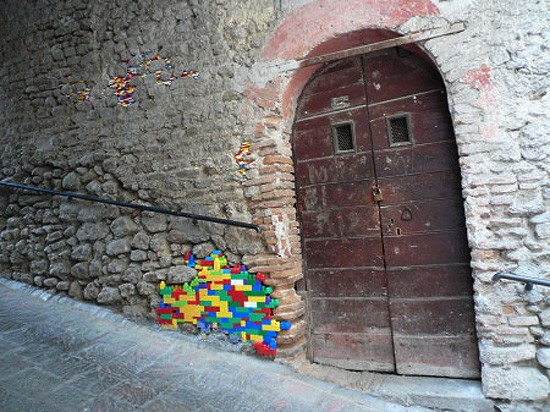
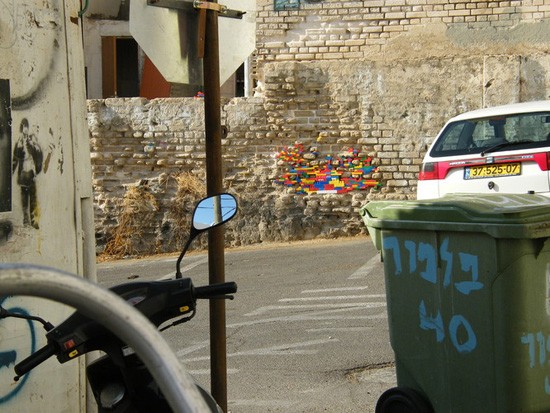
Jan Vormann is an internationally recognized artist who fills holes in the wall with legos....
What is it that you do? How do you define your work?
I work on a variety of subjects, using very different materials. Over the course of the last 5 years, it has become clearer to me, what my focus rests on: I generally work on two fields; for inside gallery spaces I develop kinetic objects and outside, in the streets, I try to intervene in people's daily routines with installations in public space, which sometimes just happen to be kinetic mechanisms as well. Within both fields you might recognize my interest in the examination of "the ephemeral" or, in other words, dealing with decay over certain periods of time.
For me, it is important to use recognizable objects, or objects of symbolic value, in order to permit an emotional access to the work. Whereas some artists develop works which are meant to be understood by "insiders" only, I am flattered if my works mean something to people who are both "insiders" or "outsiders" to the art world. I also believe that in arts, there shouldn´t be people left out on purpose. Of course, for some of my works you need a bit of background information, but for some you plainly don't, because they are easy to "enter.”
I think that, for example, my work revolving around soapbubbles or plastic toy construction pieces bears an "emotional access" to many spectators worldwide, because both are "global obects" with high value of recognition; without having facts for back-up – based solely on my experiences while travelling - I estimate that the vast majority of the world population has at least once in their childhood held these toys in their own hands and has played with them. Having said that, I believe that it is generally possible to find, in the western world especially, emotional connections to these "little plastic bricks.” Now, if you want, the project can be seen as more than just plainly repairing walls with toys. First, I think, it establishes a link between the gathering of basic architectural principles while playing as a kid, with the consequential use of this playful study later in life: the construction of walls in order to survive (essential for houses to live in, in order to keep vicious natural elements outside - I am not talking about walls as structures for separation between humans!) Secondly, the project shows the contrasting ideas of the perfect environment to raise kids in and the format we are then willing to live in ourselves as adults: Toys for kids are mostly very shiny and colorful - our cities, especially metropolises, are mostly dull and grey. There are people who try to change this discrepancy - e.g. streetartists - but they are mostly doing it on their own costs and with the risk of getting caught. Maybe, to change the discrepancy, we should do it the other way around, and sell grey toys to the people who enjoy living in grey cities, so they can raise their kids to get "the right idea" about what to expect later in life.
What inspired you? How did you get started?
The world is full of inspiration. Everything has the potential to inspire somebody. My "problem" is that I get inspired very easily. What I mean is, that if I talk to a mathematician who enthusiastically speaks about his work, I can easily get carried away and forget, for example, that, the day before, an enthusiastic gardener inspired me to let myself get carried away by thoughts about his domain. Nonetheless, I don´t think that this is the worst flaw to have, if you want to call it a flaw at all. So, for my works, the inspiration lays somewhere hidden out there, just waiting to jump into appearance.
In terms of what has inspired me in the field of arts, the historical inspiration, there have been many artists in the past, and there are many contemporary artists I enjoy. I have let myself be influenced a great deal by surrealist painters and poets of the absurde: Magritte, Vian, Ionesco... and constructivist sculptors like Gabo and Tatlin. It is absurd when Eugene Ionesco writes about how a whole city physically transforms into rhinoceroses, or when the train tracks in Boris Vian's book "Autumn in Bejing" lead exactly through the one solemn house in the middle of nowhere - and all the little details in their stories, that seem to not bear any truth or connection and be purely fictional and irrational. Nonetheless, I think that the human mind is capable of reading in between these sometimes rationally confusing lines and find out what is really meant by the author. In a way, I think this silent, cryptic manner of writing is sometimes a more comprehensible approach for the understanding and perception of the (sometimes seemingly absurd) world we live in, as opposed to just plainly trying to formulate what one estimates to be "the truth" in simple, understandable words and commonly used factual terminology and then going out and screaming about it as loud as possible.
To get back to the Dispatchwork project: the inspiration for that project came when I strolled through the little city of Bocchignano in Italy. The foundation walls there are made from construction materials dating back to the times of the Roman empire. As I come from Bamberg, a little "medieval city" in Germany, where restoration of the buildings has a big importance, I am familiar with restoration practices. In Bocchignano, these walls of old substance were reconstructed in the course of time lead by the necessity of a stable house to live in, and by no means by the visual appearance and design. As construction materials have changed since, and also availability in terms of financial possibility, of course people couldn´t care less about the appearance - they wanted to ensure a secure shelter for their families. This given patchwork then, lead me to the assumption, that, as a kid, I did the same thing while building structures: When trying to build structures, and a certain stone of the matching color wasn´t available (or I couldn´t find it somewhere deep down in the box) I just had to help myself by using one of a different color - giving up visual unison but gaining structural integrity. So this is the reason, why for the project I am intentionally not trying to use stones of colors that match the walls, but trying to achieve exactly the opposite: to build patches where, in itself, no stone of a certain color, sits next to one of the same color - making it as colorful as possible.
I am very fond of street-art/Graffity/Art in Urban Spaces. Having lived and worked in Berlin for the last years, I have constantly been around people, involved or exposed to "putting colorful stuff on walls" - But instead of becoming subject to persecution by law-enforcement, I wanted to create a "clean" project: One that wasn´t considered "vandalism" (in fact, Dispatchwork is a form of repair!) and further, to develop a project that even people who despise street-art/graffity culture might appreciate.
How has your process evolved over the years?
When the project was first up on the Internet, it gave people from all over the world the possibility to see it. Some of them reacted in a very positive way and invited me to their locations. With the generous support of many private persons or institutions (find the complete list here: http://www.dispatchwork.info/links ) I was then able to recreate the project in many cities. The concept since has been the same: although pretty much every city has a different architecture, the basic principles, of course, are the same: A brick, placed on top of another brick - with decay being a universal fact anyways. What happened further is that at some point people started sending in their own repairs. The first one was sent to me from Australia. I remember very well, because from Germany, it is literally on the other side of the planet. I was overwhelmed about the distance that the knowing about my project had travelled through the internet, and then kind of "jumped out of cyberspace" and was materialized by the hands of other people. This had never happened to me so far. I think, for example, a musician feels the same when he hears people singing a song that he once wrote. It´s truly amazing. I am so thankful for all the positive responses I have gotten so far!
Tell us about your favorite or most recent project.
Of course I enjoy the positive effects of the Dispatchwork Project, which means travelling to different places, getting to know friendly people, playing/working with them in the streets... Still, my most favorite project is generally always the latest, newest project. So, at the moment, it is the SLEM4 - the soapbubble life extension machine 4. In 2007 I have started to design these SLEM devices which would maintain a standard (commercially available) Soapbubble. Every SLEM is considered a prototype in the search for the longest lifespan-extension of a medium-sized soapbubble. The longest so far achieved period is 4,5 hours, on 4th July 2009. Again, using a globally recognizable object: the soapbubble, my intention here lays in the examination of the ephemeral. Undoubtedly one of the most fragile objects (if not THE most fragile) in the world is tried to be kept intact. It is an absurd wish - I see a bit of a parallel with Terry Schiavo, a lady which was kept "alive" for the sake of the beauty of life itself somewhat beyond reason - she was clinically dead long before the machines for her life support were turned off (The story was in the news a couple of years ago.) Besides this, and more importantly from the point of view of a sculptor, I was motivated by the idea to include the soapfilm as a material itself inside the sculpture. Of course the material, following its properties, breaks quickly - then, the object/sculpture is itself "broken.” Probably, if a collector bought the machine while the object was containing a soapbubble, and the bubble bursted, it could be a case for the insurance - although, it is very unlikely that any insurance would at all insure an object that included a soapbubble as for damage.
How do you get your best ideas?
I recently read an article about creative processes - some scientists say, that in order to create new ideas, you need to be subject to a couple of circumstances: First, to be free, or open enough in your mind to reconnect existing data in a new way - without fear of "making mistakes" meaning to create nonsense or to lose productive time. I agree with this first point, as well as with the second: you need leisure-time in order for your mind to be able to settle down, and to let yourself be distracted from essential necessities / the daily routine for accomplishing the necessary.